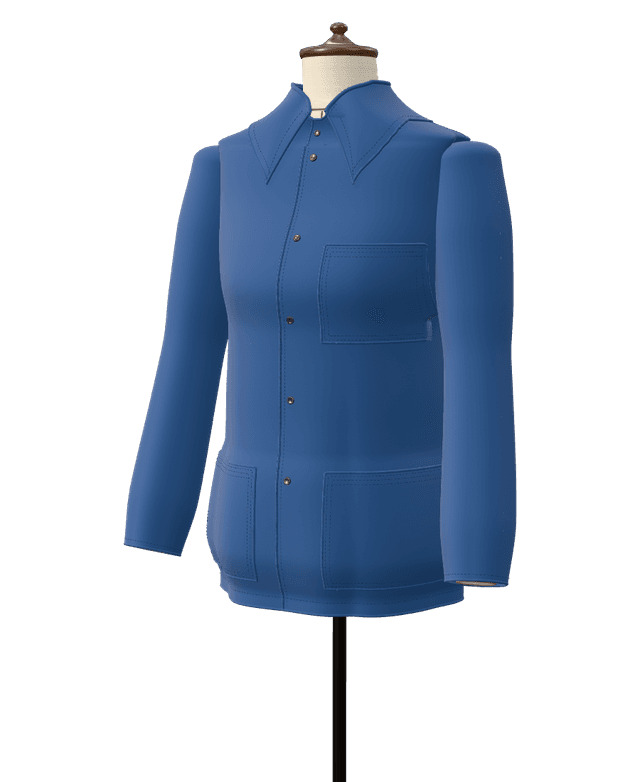
A waistcoat, or suit vest, is a close-fitting sleeveless garment worn over a shirt: a V-neck, a buttoned front, small welt pockets and two points at the lower front edge. It is fully lined, and a strap with a buckle at the back adjusts the fit at the waist. Sewly drafts it with a fitted cut from your bust or chest, waist and back waist length, with darts to shape it.
Waistcoat options
Every option redraws the pattern instantly, without using any AI:
- Fit: fitted (the default), regular, relaxed or oversized, with an ease adjustment.
- Length: waist length plus 6 cm (2 3/8 in) by default, with a length adjustment of up to 25 cm (10 in) either way.
- Neckline: a V-neck lowered by 6 cm (2 3/8 in) by default, with depth and width adjustments.
- Buttons: five of 15 mm (5/8 in) by default; set any number up to 14 and any size up to 3 cm (1 1/8 in).
- Pockets: one chest welt pocket and two lower welt pockets by default, or patch or jetted flap pockets, or none.
- Hem: pointed fronts (default) or a straight hem.
- Back strap: a strap with a buckle (default), or none.
- Darts: bust and waist darts by default; men's and children's versions keep the waist darts only.
- Lining: a full lining, on by default; topstitching is off for a clean, tailored finish.
Made to measure or a standard size
Use your own measurements or a standard size: women's EU 32–54 (US 0–22, UK 4–26), men's XS to 3XL, or children's 2 to 14 years. A waistcoat fits close, so measure your bust or chest and waist carefully, and make a toile before cutting good suiting.
Best fabrics for a waistcoat
Wool suiting, tweed, linen, cotton drill or brocade for the fronts, and satin or lining fabric for the lining, or for the back if you want the traditional contrast. Match the fronts to a suit, or choose tweed or brocade for a waistcoat worn on its own. Our post on sewing with wool covers pressing suiting.
How hard is it to sew?
A project for confident sewists. There are few pieces, but each welt pocket must be cut and turned precisely, and the lining is bagged: sewn to the shell by machine, then turned right side out through a gap in a side seam. Allow 8 to 10 hours.
What's in the pattern
- Two fronts and a back cut on the fold
- A chest welt and two lower pocket welts, with pocket bags cut from lining
- Front facings, with their interfacing
- Front and back linings
- Four back strap pieces
Notions: five 15 mm (5/8 in) buttons, medium-weight fusible interfacing and a small buckle for the back strap. The guide lists every piece with its cut count, the notions with their quantities, the quantities of main fabric and lining for 110, 140 and 150 cm (45, 55 and 60 in) wide fabric, and a cutting layout.
How to sew a waistcoat
- Fuse the interfacing, staystitch the neckline and sew the darts.
- Make the chest and lower welt pockets.
- Sew the shoulder seams, then make the back straps and baste them to the back.
- Sew the front facings to the front linings, and sew the side seams of the shell.
- Assemble the lining and bag it: sew it to the shell around the front, neck and lower edges, turn the waistcoat through a gap, then close the armholes.
- Make the buttonholes, sew on the buttons and press.
Our posts on how to sew welt pockets and lined vs unlined garments cover the two techniques that define a waistcoat.
Frequently asked questions
How much fabric do I need for a waistcoat?
An adult waistcoat usually takes about 0.8 to 1.2 m (7/8 to 1 3/8 yd) of 140 to 150 cm (55 to 60 in) wide main fabric and about 0.8 to 0.9 m (7/8 to 1 yd) of lining. Sewly computes both quantities for your size and fabric width.
Is the waistcoat for men or women?
Both, and for children too. The women's version is shaped with bust and waist darts; men's and children's versions use waist darts only. Choose a standard size or enter your own measurements.
Can I make it without a lining?
Yes. With the lining off, the armholes and neck are faced and the lower edge is hemmed instead. The lining gives the cleanest inside, though, and hides the welt pocket bags.
Can I make matching trousers?
Yes. Cut the chinos pattern in the same suiting with one or two pleats and turn-ups for tailored trousers. A jacket with notched lapels is not in Sewly's catalogue: its AI pattern maker drafts one as a new, untested design, so sew a toile first.