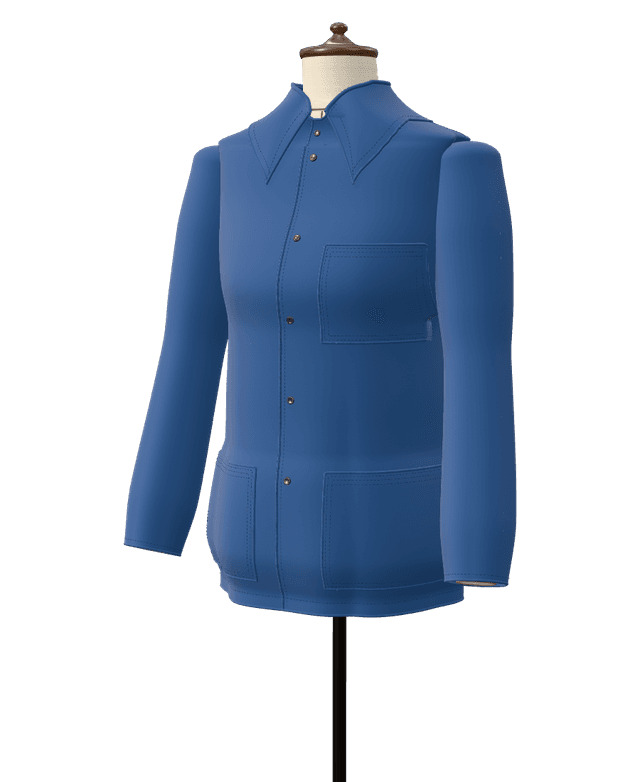
A trucker jacket is the denim jacket most people picture: a short, boxy jacket with pointed yokes front and back, two vertical seams down each front, buttoned flap pockets on the chest and a waistband with button tabs at the back. Every seam is flat-felled and topstitched, which is what makes it last, and what makes it a project for experienced sewists. Sewly drafts it with jacket ease from your bust or chest, shoulders and arm length, so it fits over a shirt.
Trucker jacket options
The defaults give the type III jacket, and every option redraws the pattern instantly, without using any AI:
- Length: high hip plus 5 cm (2 in) by default, with a length adjustment of up to 25 cm (10 in) either way.
- Fit: fitted, regular (the default), relaxed or oversized, with extra chest ease for a roomier jacket.
- Collar: a jacket collar on a stand, with classic (default), spread, long, rounded or button-down points and a collar size from 70 to 150 %.
- Yokes: pointed front and back yokes by default, at a depth you can move; straight or curved yokes are options.
- Chest pockets: two buttoned flaps over slit pockets sewn into the panel seams (default), with pointed, square, rounded or angled flaps; patch pockets are an option.
- Sleeves: long, with sleeve plackets and buttoned cuffs; set them to none and you have the denim vest.
- Lower pockets: none by default; add slanted welt hand pockets or patch pockets.
- Lining and topstitching: an optional full lining; topstitching on automatic uses gold contrast thread on denim and matching thread otherwise, or choose contrast, matching or none.
Made to measure or a standard size
Use your own measurements or a standard size: women's EU 32–54 (US 0–22, UK 4–26), men's XS to 3XL, or children's 2 to 14 years. There are no darts: on a women's jacket, the panel seams take the bust and waist shaping. The measuring assistant explains each measurement, and the 3D preview shows the length and fit on a mannequin built from your numbers.
Best fabrics for a trucker jacket
Denim of 11 to 14 oz, selvedge denim, cotton canvas, corduroy, cotton twill or moleskin. Prewash denim before cutting, because it shrinks. Folding heavy denim through flat-felled seams is hard on a light machine: our post on sewing machines for denim and canvas explains what helps, and sewing with denim covers needles and thread.
How hard is it to sew?
It is rated for experienced sewists, the highest level in Sewly's library. There are more than twenty pieces, and the steps include flat-felled panel seams, chest pockets set into those seams under buttoned flaps, a collar on a stand, sleeve plackets and cuffs, a waistband with tabs, and metal tack buttons set with a hammer. Plan on two or three weekends, and test your topstitching on scraps folded to the thickness of the seam crossings.
What's in the pattern
- Front, front panel and side front, each cut as a pair, and two front yokes
- Back on the fold, two side backs and the back yoke
- Two sleeves with their sleeve plackets and underlaps, and four cuff pieces
- Collar and collar stand, each cut twice
- Four chest pocket flap pieces and the pocket bags
- Front facings, the waistband (given as cutting dimensions) and four adjuster tab pieces
- Interfacing pieces for the cuffs, collar, stand and front facings
Notions: metal jeans (tack) buttons, 17 mm (11/16 in), twelve on an adult jacket for the front, flaps, cuffs, tabs and waistband; medium-weight fusible interfacing; two spools of topstitching thread; jeans needles 100/16 and a topstitch needle 90/14. The guide lists every piece with its cut count, the notions with their quantities, the fabric quantity for 110, 140 and 150 cm (45, 55 and 60 in) wide fabric, and a cutting layout.
How to sew a trucker jacket
- Fuse the interfacing, set up for topstitching and practice a flat-felled seam on scraps.
- Make the flaps and sew the chest pockets into the panel seams, then join the panels.
- Attach the pointed front and back yokes, sew the shoulders and attach the front facings.
- Make the collar and sew it to the neckline between the two stand pieces.
- Sew the sleeve plackets, set the sleeves in flat and sew each side and sleeve seam in one pass.
- Make and attach the cuffs.
- Make the adjuster tabs and attach the waistband.
- Make the buttonholes, set the metal buttons with a hammer and press.
Our post on how to topstitch straight and even helps with the most visible part of the jacket.
Frequently asked questions
How much fabric do I need for a trucker jacket?
An adult trucker jacket usually takes 1.7 to 2.2 m (1 7/8 to 2 1/2 yd) of 140 to 150 cm (55 to 60 in) wide denim in Sewly's cutting layouts, depending on the size, plus a little lining or pocketing for the pocket bags. A child's jacket needs much less. Sewly computes the exact quantity for your size and fabric width.
Can I make it without sleeves?
Yes. The denim vest is the same jacket with no sleeves: the armholes are faced with bias strips, and the cuffs and plackets are left out.
Do I need a special sewing machine for denim?
Not necessarily. A sturdy home machine with jeans needles 100/16, a topstitch needle and a 3 to 3.5 mm stitch handles 11 to 14 oz denim if you slow down over seam crossings and keep the foot level with a hump jumper or folded card. Very heavy denim is easier on a heavy-duty machine.
Can I make it in corduroy or with a lining?
Yes. Corduroy, canvas, twill and moleskin all work with the same pattern. For a warmer jacket, turn on the full lining: Sewly adds lining pieces for the body and sleeves, sewn to the front facings.