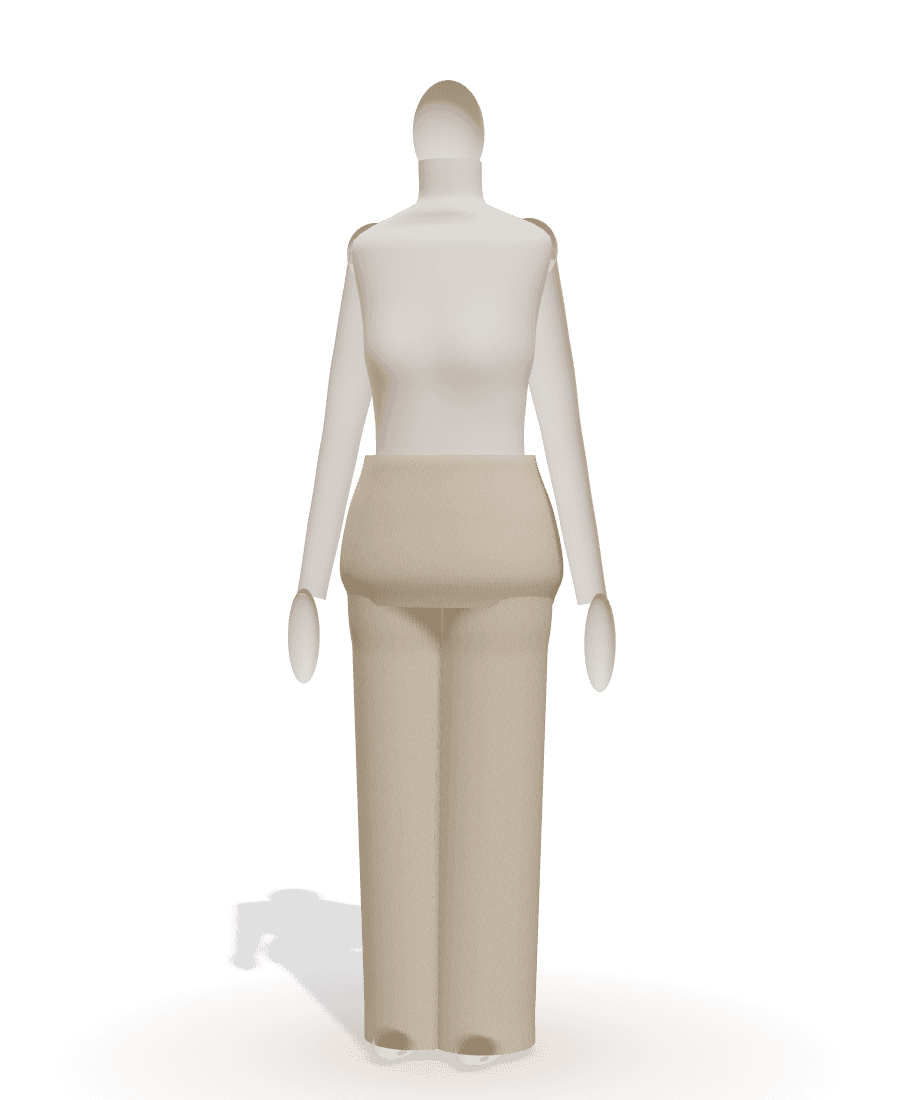
Pull-on trousers have an elastic waist instead of a fly, so they slide on without a zip or buttons. The hard part of any trousers pattern is the crotch curve, and that is where drafting from your own body helps most: Sewly shapes it from your hip, waist and seated crotch depth, then adds the leg you choose.
Pull-on trousers options
- Fit: regular, relaxed (the default) or oversized.
- Leg: wide (default), straight, tapered, or jogger with ribbed cuffs.
- Length: full (default), ankle, or cropped as a culotte, plus a length adjustment of up to 25 cm (10 in) either way.
- Elastic width: from 1 to 5 cm (3/8 to 2 in), 3 cm (1 1/4 in) by default.
- Pockets: in the side seams (default), patch pockets, or none.
There is no fly front: trousers and jeans with a zip fly are not in Sewly's library yet.
Sizes
Use your own measurements or a standard size: women's EU 32–54 (US 0–22, UK 4–26), men's XS to 3XL, or children's 2 to 14 years. Measure your crotch depth sitting on a hard chair, from the waist down to the seat: it is the number that decides whether trousers feel comfortable. The measuring assistant explains each step.
Best fabrics for pull-on trousers
Linen, viscose twill, cotton twill or Tencel for everyday trousers; cotton flannel for pyjamas; French terry for joggers. Wovens and knits both work. Drapey fabrics make the most of a wide leg; firmer twills suit straight and tapered legs. Our project post on sewing wide-leg linen trousers goes through fabric choice and pressing.
How hard is it to sew?
An advanced beginner project. There are more seams than in a skirt, and the order matters, but no zip and no fitting of a waistband. Allow 4 to 6 hours, including the pockets.
What's in the pattern
- Front leg and back leg, each cut as a mirrored pair, with a fold-over casing for the elastic at the waist
- In-seam pocket bags or patch pockets
- Two ribbed leg cuffs for the jogger, given as cutting dimensions
Notions: elastic, with the length worked out from your waist, and ribbing for jogger cuffs. The guide lists each piece with its cut count and gives the fabric quantity for 110, 140 and 150 cm (45, 55 and 60 in) wide fabric, with a cutting layout.
How to sew pull-on trousers
- Sew the pocket bags into the side seams, or topstitch the patch pockets.
- Sew the side seams, then the inseam of each leg.
- Turn one leg right side out, slip it into the other and sew the crotch seam in one curve.
- Finish the seams, fold the casing and thread the elastic.
- Hem the legs or attach the ribbed cuffs, and press.
For the pockets, see how to sew in-seam pockets.
Frequently asked questions
How much fabric do I need for wide-leg trousers?
Full-length wide-leg trousers usually take 2.2 to 3 m (2 3/8 to 3 1/4 yd) of 140 to 150 cm (55 to 60 in) wide fabric. Tapered or cropped legs take less, around 1.6 to 2.2 m (1 3/4 to 2 3/8 yd), while larger hips or 110 cm (45 in) wide fabric need more. Sewly computes the exact quantity for your size and fabric width.
Can I make pyjama trousers with this pattern?
Yes. Choose the straight or wide leg, a relaxed fit and a cotton flannel or lawn. Many people make a first pair as pyjamas to test the fit before sewing them in linen.
Can I make joggers?
Yes. Choose the jogger leg: the legs taper and finish with ribbed cuffs. French terry or sweatshirt fleece are the usual fabrics.
Does the pattern have a fly front or a zip?
No. These trousers pull on with an elastic waist. Trousers and jeans with a fly front are not in Sewly's library yet.
