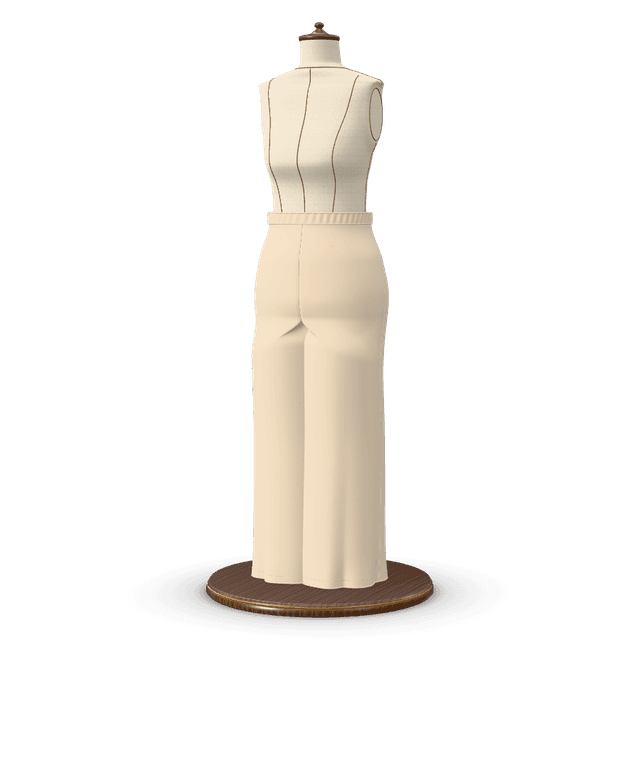
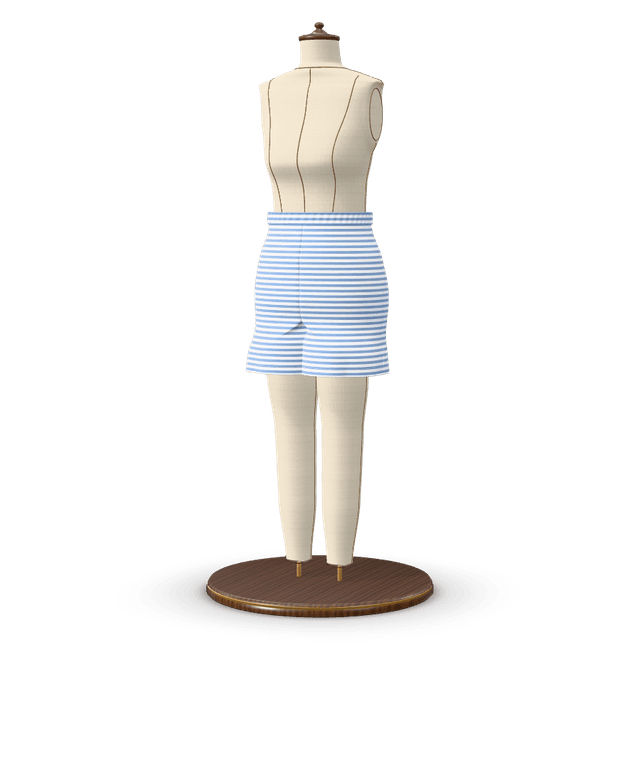
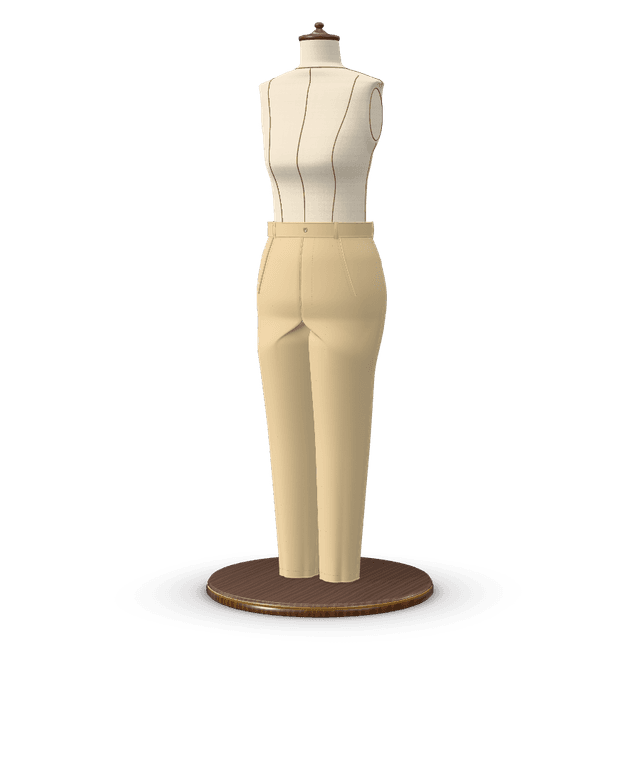
Jeans are the five-pocket trousers in denim: two scoop front pockets with a small coin pocket, two patch pockets on the back, a back yoke instead of darts, a zip fly and a waistband with belt loops, all flat-felled and topstitched. Fit is what makes jeans hard to buy, and it is where drafting from your body helps most: Sewly shapes the crotch curve and the yoke from your waist, hip, thigh and seated crotch depth, then adds the rise and leg you choose.
Jeans options
Every option redraws the pattern instantly, without using any AI:
- Rise: low, mid (the default), high or extra high.
- Leg: skinny, slim, straight (default), bootcut, flare, wide, tapered, barrel or jogger.
- Length: full (default), ankle, capri, knee, Bermuda, mid-thigh or short, plus a length adjustment of up to 25 cm (10 in) either way. The short lengths make jean shorts.
- Fit: fitted, regular (default), relaxed or oversized, extra hip ease, and a stretch setting for denim with 2 to 3 % elastane, which takes out ease so skinny and slim legs fit close.
- Waistband: straight (default) or contoured to follow the hips, useful on low rises, with the height you choose.
- Fly: a zip fly (default) or a button fly.
- Pockets: scoop front pockets with a coin pocket and pointed patch back pockets by default; cargo pockets can be added.
- Hem and topstitching: a plain hem (default) or a turn-up; topstitching on automatic uses gold contrast thread on denim and matching thread otherwise, or choose contrast, matching or none.
Made to measure or a standard size
Use your own measurements or a standard size: women's EU 32–54 (US 0–22, UK 4–26), men's XS to 3XL, or children's 2 to 14 years. Measure your crotch depth sitting on a hard chair, from your waist down to the seat: it sets the rise. Our post on crotch depth vs crotch length explains why that number matters so much for jeans.
Best fabrics for jeans
Denim of 10 to 14 oz, stretch denim, selvedge denim, black denim, corduroy or cotton twill. For a close fit, choose stretch denim and turn on the stretch setting; rigid denim needs the regular ease. Prewash the denim before cutting, because it shrinks. Our post on sewing with denim covers needles, thread and seams.
How hard is it to sew?
Jeans are rated for experienced sewists, the highest level in Sewly's library. The steps are many and precise: back pockets with decorative stitching, flat-felled yoke seams and inseams, scoop pockets with facings and bags, a zip fly with a fly shield, a waistband with an underlap, belt loops, and a jeans button and rivets set with a hammer. Thick seam crossings test a home machine. Allow two weekends for a first pair.
What's in the pattern
- Fronts with the fly extension cut on, and backs, each cut as a pair
- Two back yokes and two pointed back pockets
- Pocket facings, a coin pocket and four front pocket bags in pocketing
- Fly shield
- Waistband with its underlap, and a strip for five belt loops, both given as cutting dimensions
Notions: a metal jeans zip, a 17–20 mm (11/16–3/4 in) jeans tack button, ten rivets, fusible interfacing for the waistband and fly, two spools of topstitching thread and jeans needles 100/16. The guide lists each piece with its cut count, the notions with their quantities, the fabric quantity for 110, 140 and 150 cm (45, 55 and 60 in) wide fabric, and a cutting layout.
How to sew jeans
- Set the machine up for topstitching and practice a flat-felled seam on scraps.
- Stitch the decoration on the back pockets, sew them on and attach the back yokes.
- Make the front pockets with their facings, bags and coin pocket.
- Sew the zip fly with its shield, then the center back seam.
- Flat-fell the inseams, then sew the side seams.
- Make the belt loops and attach the waistband.
- Hem the legs, set the button and rivets, and press.
Our post on how to sew a flat-felled seam shows the seam you will sew most often, and how to topstitch straight and even helps with the rows that show.
Frequently asked questions
How much fabric do I need for jeans?
Full-length adult jeans usually take 1.4 to 2.4 m (1 5/8 to 2 5/8 yd) of 140 to 150 cm (55 to 60 in) wide denim in Sewly's cutting layouts, plus a little pocketing for the bags. Shorts and children's sizes need much less, 110 cm (45 in) wide fabric more. Sewly computes the exact quantity for your size, leg and fabric width.
Can I make high-waisted wide-leg or mom jeans?
Yes. Choose the high or extra high rise with the wide leg for wide-leg jeans, or with the tapered leg and a relaxed fit for mom jeans. The barrel leg gives the curved, roomy knee of recent styles.
Do I have to use rivets and a jeans button?
They give the classic look and reinforce the pocket corners, and the guide shows how to set them with a hammer after testing on scraps. You can bar tack the corners instead of riveting them; the waistband still closes with a button.
Can I sew jeans on a home sewing machine?
Yes, with jeans needles 100/16, a longer stitch for topstitching and patience at the thick seam crossings, where a hump jumper or folded card under the presser foot keeps it level. Very heavy denim is easier on a heavy-duty machine; see sewing machines for denim and canvas.