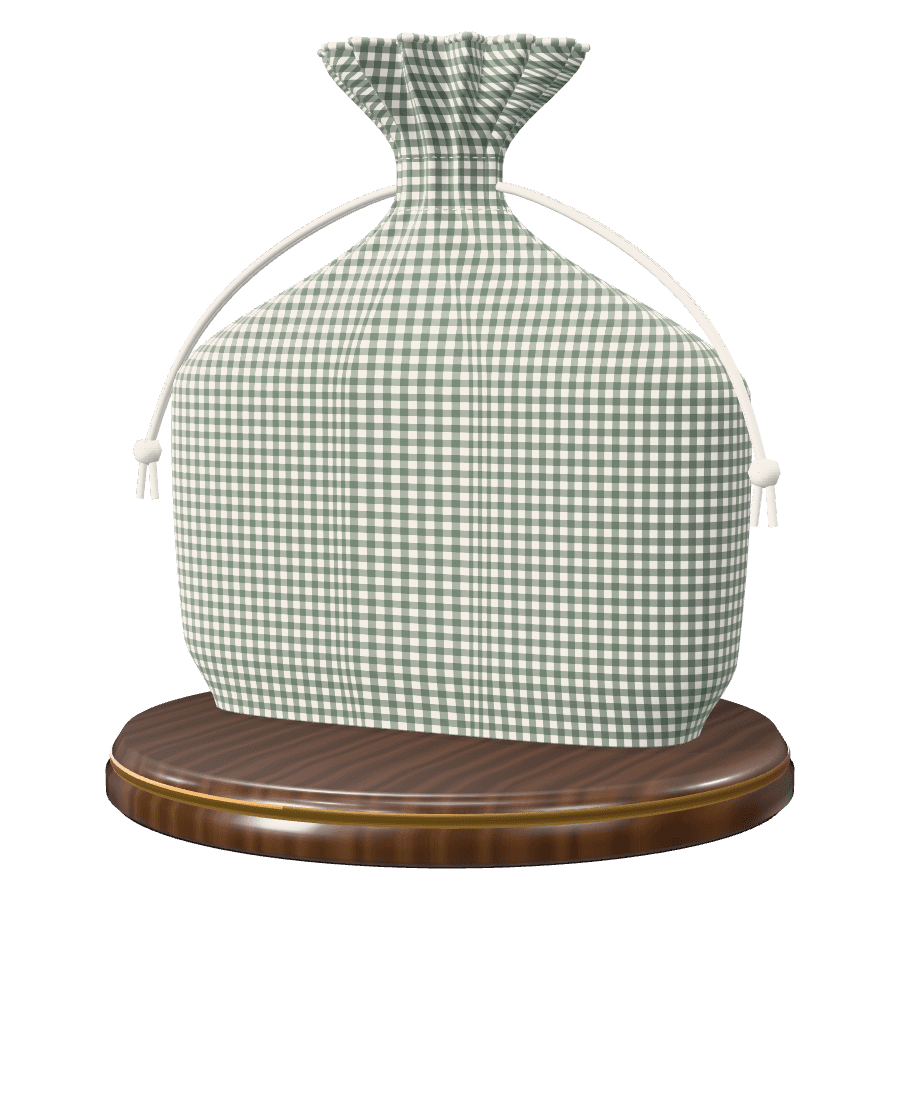
A drawstring bag is a fabric bag closed by a cord threaded through a channel at the top: pull the cord and the opening gathers shut. It is one of the quickest bags to sew, with straight seams, no zip and no handles, and it carries shoes, toys, a gift, a packed lunch or gym kit. Sewly draws the pattern to the width, height and depth you enter, so the same pattern makes a small gift pouch or a large kit bag.
Drawstring bag options
- Width: from 15 to 50 cm (6 to 19 3/4 in), 30 cm (11 3/4 in) by default.
- Height: from 15 to 60 cm (6 to 23 1/2 in), 35 cm (13 3/4 in) by default.
- Depth (boxed corners): from 0 to 12 cm (0 to 4 3/4 in), 0 by default, which gives a flat bag. Add depth for a flat base that holds shoes or a lunch box upright.
- Cords: one cord, or two cords pulled from both sides (the default), which close the bag more evenly.
- Lining: on by default. Without it, the bag is a single layer, lighter and quicker to sew.
No body measurements are needed: the size comes from what you want to carry. As a starting point, a gift pouch is around 20 × 25 cm (8 × 10 in), a lunch bag around 30 × 35 cm (12 × 14 in) with 8 cm (3 in) of depth, and a bag for a pair of adult shoes around 35 × 45 cm (14 × 18 in).
Best fabrics for a drawstring bag
Firm, closely woven fabrics: cotton canvas for shoe and sports bags, quilting cotton for gift bags and linings, linen for a soft look, denim for a bag that takes knocks, and ripstop for a light bag that dries quickly. A lining in quilting cotton hides the seams and makes the bag sturdier. Avoid very thick fabric at the top, where the cord has to slide through two layers.
For the cord, a cotton or braided cord 4 to 6 mm (3/16 to 1/4 in) thick runs smoothly. Ribbon, paracord or a narrow tube sewn from the same fabric work too.
How hard is it to sew?
A beginner project. If you can sew a straight seam, you can make this bag. Allow about an hour for an unlined flat bag and 1 to 2 hours for a lined bag with boxed corners. It is also a good project for sewing with kids: straight lines, a quick result and a bag they will use every day.
What's in the pattern
- Outer bag pieces, with the boxed corners cut out when you add depth
- Lining pieces, the same shape (lined version)
Notions: cord for one or two drawstrings. Without depth the pieces are plain rectangles, so you can also mark them straight onto the fabric from their dimensions. The guide gives the fabric quantity for 110, 140 and 150 cm (45, 55 and 60 in) wide fabric with a cutting layout, and the PDF, with the pattern at true scale and the sewing guide, prints free on every plan, the free plan included.
How to sew a lined drawstring bag
- Cut the outer pieces and the lining pieces.
- Sew the sides and bottom of the outer bag, leaving a small gap in the side seam at the height of the channel for the cord to come out: on one side for one cord, on both sides for two.
- Box the corners if your bag has depth, then sew the lining the same way, leaving a turning gap in its bottom seam.
- Put the outer bag inside the lining, right sides together, sew all around the top edge and turn the bag through the gap in the lining.
- Close the gap, push the lining inside, press, and sew two lines around the top to make the casing for the cord.
- Thread the cord through the casing with a safety pin and knot the ends.
On an unlined bag, finish the seams with a zigzag (see finishing seams without a serger) and fold the top edge twice to make the casing. A drawstring bag is also wrapping that becomes part of the present: see more handmade gifts you can sew in a weekend.
Frequently asked questions
How much fabric do I need for a drawstring bag?
At the default size, about 0.4 to 0.5 m (1/2 yd) of outer fabric and the same of lining on 110 to 150 cm (45 to 60 in) wide fabric. A large bag with depth can need 0.8 m (7/8 yd) or more of each, especially on 110 cm (45 in) wide fabric. Sewly computes the exact quantity for your size and fabric width.
One cord or two: which is better?
Two cords, threaded in opposite directions and pulled from both sides, close the bag evenly and are the classic choice for shoe and gym bags. One cord is quicker to thread and suits small gift and toy bags.
Which cord should I use for a drawstring bag?
A cotton or braided cord 4 to 6 mm (3/16 to 1/4 in) thick slides easily through the casing and knots well. Ribbon suits gift bags, paracord suits bags that carry weight, and a tube sewn from the same fabric matches the bag.
Can the bag have a flat base?
Yes. Give it a depth of up to 12 cm (4 3/4 in) and the bottom corners are boxed, which gives the bag a flat base. At 0 the bag stays flat, like a pouch.
Is the drawstring bag pattern free?
Yes. The drawstring bag is one of six very easy models, with the tote bag, scrunchie, headband, cushion cover and apron, that print free on every Sewly plan, the free plan included: download the true-scale PDF and its sewing guide without a subscription. On the free plan, changes by hand are unlimited and changes asked in words are limited to 2 per pattern.