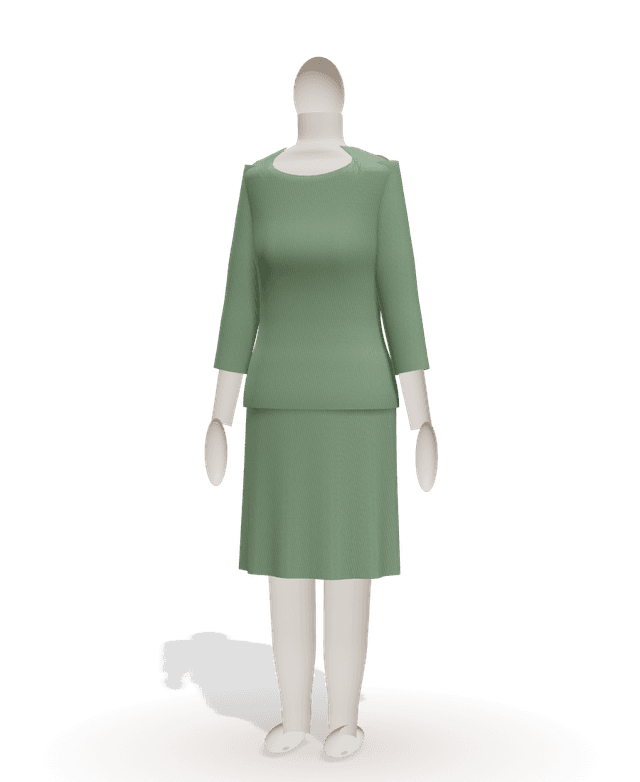
A slip dress is a sleeveless dress on thin straps, cut on the bias so it drapes over the body and moves as you do. The top edge and straps are finished with bias binding, and there is no zip: the bias gives the dress enough give to pull on over the head. Sewly drafts the front and back from your bust and hip measurements, with the length and flare you choose.
Slip dress options
- Length: mini, above the knee, knee, midi (the default) or maxi, plus a length adjustment of up to 25 cm (10 in) either way.
- Neckline: straight, V (default) or soft cowl, which is a deeper V.
- Flare at each side: 0 to 18 cm (0 to 7 in), 6 cm (2 3/8 in) by default. More flare gives a fuller, more fluid hem.
There are no sleeve or closure options: the slip dress keeps its simple shape, and the work goes into handling the fabric.
Sizes
Use your own measurements or a standard women's size, EU 32–54 (US 0–22, UK 4–26). Bust and hip set the width; your waist-to-knee or waist-to-floor length sets the hem. The 3D preview shows the silhouette and proportions on a mannequin built from your numbers, though not the exact drape of satin or silk.
Best fabrics for a slip dress
Fluid, lightweight wovens: satin, silk charmeuse, viscose crepe, cupro or sandwashed silk. They are slippery and fray easily, so the pattern's notions include a fine Microtex 60/8 needle and tissue paper to stabilize the seams under the presser foot. Our post on sewing viscose covers cutting and pressing fluid fabrics.
How hard is it to sew?
Intermediate, not because there are many steps (there are few) but because bias-cut, slippery fabric shifts, stretches and frays. Cut it in a single layer with pattern weights, handle the pieces as little as possible, and allow 4 to 6 hours of sewing plus a night for the dress to hang before you level the hem.
What's in the pattern
- Front and back, each with a bias grainline at 45 degrees
- A bias strip for the top edge binding, given as cutting dimensions
- Two spaghetti straps, sewn as narrow tubes and turned
Seams are finished as French seams, which enclose the raw edges and suit sheer or fraying fabric. The guide lists the fabric quantity for 110, 140 and 150 cm (45, 55 and 60 in) wide fabric, with a cutting layout laid out for the bias.
How to sew a slip dress
- Cut each piece on the bias, single layer, and mark it lightly.
- Sew the side seams as French seams, with tissue paper under the fabric if it puckers.
- Make the straps and turn them right side out.
- Bind the top edge, catching the straps in the binding.
- Let the dress hang overnight, level the hem, then sew a 1 cm (3/8 in) narrow hem and press.
For a full walkthrough with photos of each stage, see our project post on sewing a bias-cut slip dress.
Frequently asked questions
How much fabric do I need for a bias-cut slip dress?
Cutting on the bias takes more fabric than cutting on the straight grain. A midi slip dress usually needs 2.5 to 3.5 m (2 3/4 to 3 7/8 yd) of 140 cm (55 in) wide fabric; a mini needs less, a maxi or narrow fabric more. Sewly computes the exact quantity for your size and fabric width.
Do I have to cut a slip dress on the bias?
Yes, the pattern is drafted for it. The fabric's give on the diagonal is what lets the dress skim the body and pull on without a zip. Cut on the straight grain, it would hang stiffly and could be hard to get on.
Why let the dress hang before hemming?
Bias-cut fabric stretches under its own weight, and not evenly. Hanging the dress for a night lets it settle, so you can level the hem once instead of finding it uneven after the first wear.
Can I sew a slip dress as a beginner?
It is possible if you are patient, but slippery fabric is hard to control. A good plan is a first version in viscose crepe, which behaves better than satin, before moving on to silk.